Why Village Grounds Have Boundaries of Their Own
Village cricket ground boundaries follow the land around them. Learn how trees, roads, slopes and field shape create a playing space with local character.
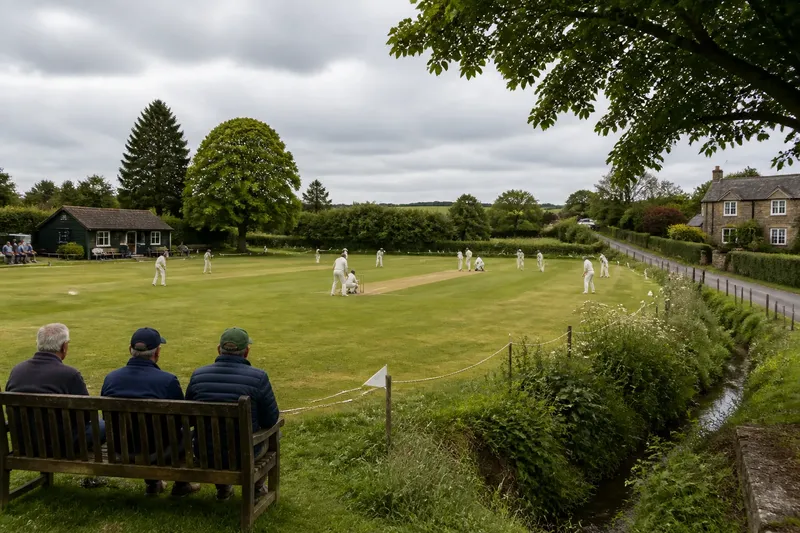
Why do village cricket ground boundaries seem to change from one match to the next? The answer is often visible from the square: a tree line, a lane, a ditch or a field edge can shape the playing space as much as the pitch does. A village ground rarely begins with a blank sheet of turf, and its boundary reflects the land the club has to work with.
What counts as the boundary on a village ground?
The boundary is the line agreed for play, not necessarily the edge of the mown grass, the fence or the property. It may be marked by a rope, cones or other clear indicators, with the precise arrangement depending on the ground and the match. A nearby hedge can provide a useful visual reference, but it does not automatically become the playing boundary.
That distinction matters because the boundary must be understandable to players, officials and spectators. If the ball travels towards an uneven bank or a gap between trees, everyone needs a shared idea of where it has gone out of play. A visible marker usually does more for clarity than a confident gesture from the nearest fielder.
On a compact ground, the marked line may follow a shape that looks more like a broad oval than a circle. One side might reach towards open pasture, while another bends around a pavilion or established trees. The result is not a flaw to be corrected; it is the outline of the space the club can use.
Why is one side often shorter than the other?
A ground’s surroundings constrain how far the boundary can be set. A road, house, car park, stream or neighbouring land may leave less room in one direction. Open land on the opposite side can allow a longer reach, so the two ends of the same ground acquire different distances and different hazards.
Clubs may also need to keep play away from features that are difficult to protect or unsuitable for regular ball strikes. A greenhouse beyond a garden fence is a fairly persuasive argument for a shorter boundary, even if the fence itself is not especially imposing. On other grounds, a ditch or a steep bank can make an apparently generous outfield less usable than it looks from the pavilion.
The playing area therefore follows a negotiation between space and practical limits. It has to fit the available land, leave room for safe movement and make the boundary identifiable. The resulting shape can be asymmetrical without being arbitrary.
How do trees and hedges shape the playing space?
Trees and hedges can form a backdrop, a windbreak or a physical limit to the outfield. Their roots may affect mowing and drainage, while low branches can complicate a ball’s route. A line of mature trees may also make it difficult to see where the field ends, which is why a rope or marker can still be useful even when the natural edge seems obvious.
In some places, the club can place a boundary in front of the trees, keeping the play area legible and limiting how often a ball disappears into undergrowth. Elsewhere, a hedge may sit well beyond the marked line and serve only as a backdrop. These arrangements are local decisions rather than a universal rule about how close play should come to vegetation.
The character of the ground changes with the season, too. A bare hedge in early play can make an open boundary easy to read; dense summer growth may hide the same line. Fallen leaves, cuttings and low branches can all affect how clearly players judge the edge. The marker is there to settle the question, not to make the landscaping behave.
What difference do slopes, ditches and drains make?
A slope changes more than the view. It affects how a ball runs, how the outfield drains and how much usable space lies beyond the pitch. A ball hit uphill may slow while one sent downhill can gather pace, so a boundary set at the same apparent distance on each side will not necessarily feel equivalent in play.
Ditches and drains impose a more direct limit. A narrow channel can be hard to spot from the square, particularly in long grass, and a boundary placed beside it may be difficult to mark clearly. A wet hollow can also remain soft after the surrounding turf has dried, making it a poor place for regular running or fielding.
These features help explain why a boundary may curve around a low patch or stop short of an awkward bank. The shape follows the ground that can be used, rather than an ideal diagram. What looks like a small deviation on a plan can be an obvious practical choice once the surface is underfoot.
How does a road or neighbouring property affect the boundary?
A road, garden or shared field can determine where a ball must stop, even if there is plenty of open-looking space beyond the boundary. The playing line may sit well inside a fence to keep the ball clear of traffic, protect nearby property or preserve access for other land users. The visible boundary should make that limit clear to everyone on the ground.
Where a lane runs close to the outfield, clubs may arrange the playing area to keep fielders and spectators away from it. A hedge can separate the ground from a garden, but it is not a substitute for a clearly understood boundary. Nor does an apparent gap in the hedge mean the club can use the land beyond it.
Say a village ground has an open pasture on one side and a narrow lane beyond the other. The club could mark the pasture side near the usable edge, then set the lane side further in and make that line conspicuous. Players would have two visibly different boundaries, but a more predictable playing space and less confusion about where a struck ball belongs.
How do grounds make an uneven boundary easy to read?
A boundary is most useful when its shape can be followed from different positions around the ground. A rope can show a continuous line, while cones or flags can mark a route where a rope would be awkward. The choice depends on the surface, the layout and how easily the markers can be seen against the grass.
Clubs often have to account for interruptions: a gate, a pavilion corner, a slope or a stretch where the boundary line bends. Markers placed only at the corners may leave long sections open to interpretation. Clear spacing and a consistent route help players judge whether a ball has crossed the line without relying on a nearby spectator’s sense of direction.
The line should also make sense from the square. A boundary that is clear at ground level may disappear behind a rise or blend into a hedge from the batter’s view. Keeping that sightline in mind can help a club choose markers that are noticeable without turning the outfield into a small obstacle course.
Who decides where the boundary goes?
The club or ground organisers generally set up the playing area for the fixture, with the match officials needing to understand the arrangements. The boundary may be affected by the competition, the state of the ground and any features that limit where play can take place. A line used in one match should not be assumed to apply unchanged to another.
Before play, players and officials can clarify which markers define the boundary and how any unusual feature is treated. This is particularly useful where a natural edge sits near the marked line or where the playing area has a bend that is not obvious from the pitch. A brief agreement prevents a boundary decision from becoming a debate about the hedge, the rope and local memory all at once.
The exact arrangements can depend on the applicable playing conditions, the ground and the competition’s rules. If a feature raises a genuine rules or safety question, the officials or club should settle it before play rather than improvise once the ball is in motion.
What questions do players ask about village ground boundaries?
Does the fence always mark the boundary?
No. The fence may sit inside or outside the marked playing line, and the boundary is the line established for the match. Look for the markers and ask an official if the arrangement is unclear.
Can the boundary be different at each end?
Yes. The available land and nearby features can leave one end shorter than the other. What matters is that the line is clearly defined for the match, rather than symmetrical on a map.
Why do some grounds use cones instead of a rope?
Cones can be easier to place around uneven turf, slopes or access points. They work best when the route between them remains clear enough for players to judge where the boundary runs.
Does a ball beyond a hedge automatically count as out?
Not by itself. The hedge may be beyond the playing line, or the marked boundary may sit in front of it; the match’s agreed boundary determines the answer. Check the markers rather than treating the hedge as a rule.
Why does each ground feel as though it has its own shape?
A village ground is shaped by what was already there and what the club can sensibly use. Its trees, lanes, slopes and neighbouring fields leave a pattern that a new boundary cannot simply erase. Even when two grounds have similarly sized outfields, their edges can invite different judgments because the surrounding land gives each one a different visual frame.
That local shape becomes part of how players read the field. They learn which side offers more room, where the hedge hides the markers and how the ground rises beyond the square. Such familiarity belongs to the playing space rather than to any single match; it is one reason a boundary can feel distinctive without needing a plaque or a lengthy explanation.
For anyone wondering why village cricket ground boundaries vary, the useful answer is to look outward from the pitch. The line usually tells a story about the usable land: what the club can reach, what it needs to avoid and how it makes the edge of play visible. Before settling in to watch, notice where the markers turn. On a village ground, that small bend may explain the whole place better than a perfectly round boundary ever could.