The Cricket Fixture Card Before the Club Website
The cricket fixture card recorded dates, opponents and shared obligations, showing how a village club made its season legible before online calendars.
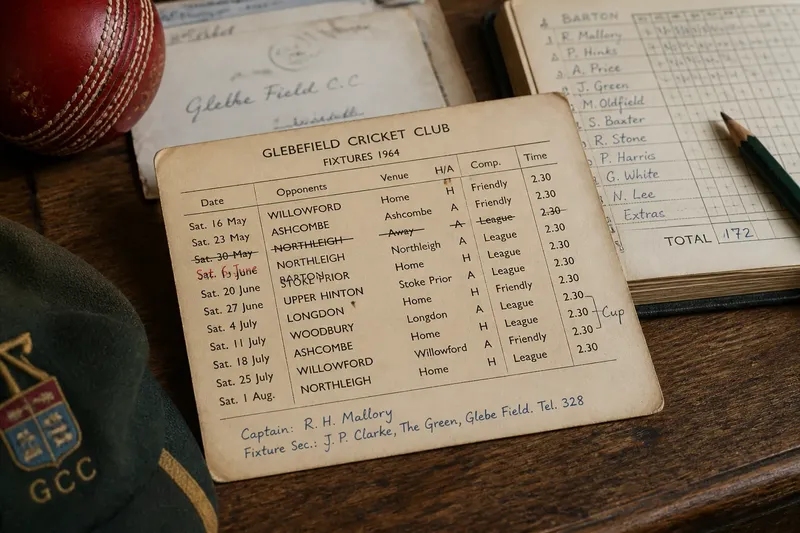
A cricket fixture card was easy to overlook beside the scorebook, but it carried the club’s season in a pocket. The cricket fixture card told players where the next match belonged in the summer, and quietly showed who was expected to remember it.
Its job was more than listing dates. A card gathered scattered arrangements into a form that could travel from the pavilion to a kitchen noticeboard, a coat pocket or the drawer where someone kept the club’s correspondence. In that small journey lay a practical kind of local history: not a grand account of cricket, but a record of how a club kept its promises to itself and its neighbours.
What did a fixture card actually record?
At its simplest, the card set out the club’s matches in sequence. It might name the opponent, the date, the venue and whether the fixture was at home or away. Some cards also noted the competition, start time, captain or contact person. The exact contents varied with the club and the space available; the important thing was that the reader could work out what was happening next.
Printed cards were often compact enough to slip into a wallet, yet detailed enough to distinguish one Saturday from another. A list that said “Ashcombe, away” was useful to a regular player who knew the district. For a newer member, adding the village or ground name could make the same entry much clearer. The card therefore balanced brevity against local knowledge. It assumed a little familiarity, but not always as much as its writer imagined.
A fixture card was also a working document. Matches could be moved, abandoned or rearranged, and a printed entry did not change when plans did. Clubs might amend a date by hand, tell members at practice or pass the news through a telephone call. The paper showed the intended schedule; the club’s communications carried the adjustments.
How did a printed list become a club message?
The card worked because it gave people a shared reference. A captain could point to an entry when discussing availability. A fixture secretary could compare it with a letter from another club. A player could check the next away date without having to remember a conversation in the pavilion. The paper itself did not organise the match, but it made the arrangement visible and repeatable.
That visibility mattered in clubs where responsibilities were spread among volunteers. One person might arrange fixtures, another collect replies, and a captain settle the side. The card joined those separate tasks by putting the agreed dates in one place. It also made the season feel like a connected sequence rather than a stack of isolated Saturdays. The early matches, the middle of summer and the closing fixtures all occupied the same small sheet.
Say a fictional village club receives a letter moving an away match from one Saturday to another. Its fixture secretary crosses out the old date on a spare card and writes in the new one, then tells the captain and asks the team noticeboard to be changed. A player who still has the first printed copy may see the alteration late, so the amended notice and a direct message matter as much as the card. The observable result is not perfect uniformity; it is a clearer route for the change to reach the people affected.
This is why the card should not be mistaken for a complete communications system. It recorded the plan, while people dealt with exceptions. Its authority depended on whether members knew it was current and whether someone took responsibility for passing on changes. Paper made a schedule tangible; it did not make the schedule immune to weather, transport or the ordinary complications of a club’s summer.
What could the card say about a club?
Even a plain fixture list carried traces of local identity. The order of opponents could reveal which neighbouring clubs formed the familiar circuit. A home-and-away pattern could show how visits were returned. Competition fixtures might sit beside friendlies, suggesting that a season included both formal commitments and matches arranged for the pleasure of playing. None of this required a note in the margin. The structure was part of the story.
Names themselves could preserve useful detail. A card might use a ground’s customary name rather than its postal address, or refer to a club by the village everyone nearby recognised. That shorthand was efficient for insiders and occasionally baffling to newcomers. It also captured a local vocabulary that could disappear from later records when grounds, teams or club arrangements changed.
The card could record what the club planned, not necessarily what took place. A match listed for a particular date might be cancelled or never completed. A fixture secretary’s copy with pencilled amendments, or a player’s card marked after the event, may therefore tell a different part of the story from a clean printed version. One is evidence of intention; the other may carry traces of revision. Treating them as identical would make the season look tidier than it was.
Why did small details matter?
Details such as “home”, “away” or a named ground reduced the chance of confusion, but they also reflected what members already knew. A club that listed only opponents may have assumed its players could place every village. A card that included directions or a contact name served a broader audience, including occasional players and people joining the club. The layout reveals a judgement about what readers needed, even if it was never discussed as a design decision.
Changes to the printed schedule could be revealing too. A handwritten strike-through might mark a rearrangement; a note beside a fixture could record that a match was a cup tie or that a return visit was expected. Such marks are not automatically a full account. They may be shorthand for the person holding the card, and their meaning can be uncertain without other club records. Still, they show the fixture list being used rather than merely issued.
Imagine a fictional club archivist sorting a box of old papers and finding two cards for the same season. One is neat and unmarked; the other has a revised date and a ground name written beside an away fixture. The archivist can place both in the season file and note the difference without claiming to know why the change happened. That modest distinction preserves useful evidence while leaving room for what the papers cannot say.
How should you read an old fixture card?
Begin with the card as an object of club administration, not as a complete match diary. Check who issued it, whether its entries are printed or handwritten, and whether there are signs that it was amended. Compare the wording with other papers from the same club if they are available, particularly fixture letters, scorebooks or annual reports. A difference between documents may reflect a change of plan rather than an error.
It helps to separate what is explicit from what is inferred. A date and opponent are direct information. A repeated pair of clubs may suggest a regular relationship, but the card alone cannot explain how that relationship began. A handwritten ground name may clarify where a match was intended to take place, though it may not establish that play went ahead. Keeping those distinctions clear makes the card more useful, not less.
If you are preserving a family or club copy, keep any annotations with it. A pencilled correction may look untidy, but removing or rewriting it can erase the very evidence that makes that copy distinctive. A simple note about where the card came from and who kept it can add context without pretending to know more than the object reveals.
What do readers often want to know?
Was a fixture card the same as a fixture book?
Not necessarily. A card was a portable summary for members, while a fixture book or secretary’s record could hold correspondence and fuller administrative details. The terms and formats differed between clubs.
Did a fixture card prove that a match was played?
No. It recorded an arranged fixture, not the result or even the fact that play began. A scorebook, match report or annotated copy may provide further evidence.
Why might two cards for one season differ?
One may have been printed before a change, while another was amended or issued later. Differences can also come from separate versions made for different uses, so the cards should be compared rather than treated as interchangeable.
What makes a fixture card useful to local historians?
It can preserve the sequence of opponents, familiar ground names and the way a club presented its commitments. Read alongside other records, the cricket fixture card helps recover how a season was arranged and communicated, not merely which matches were intended.
What does the card leave behind?
The fixture card’s modest importance lies in its place between agreement and action. It gave a club a concise account of what had been arranged, let members carry that account beyond the pavilion, and left a paper trace when the season was over. Its gaps are part of the record: alterations, assumptions and missing results all remind us that a schedule was maintained by people, not by print.
For anyone looking through village club papers, a small card deserves to be kept with the larger documents. Preserve its wording and marks, note its source, and resist turning an intended fixture into a match that certainly happened. Read carefully, the cricket fixture card offers a clear view of how a club held its season together, one appointment at a time.