Pavilion Tea or Touchline Thermos?
Pavilion tea or touchline thermos? See how each refreshment style welcomes players and spectators, and choose what suits your club’s ground and habits.
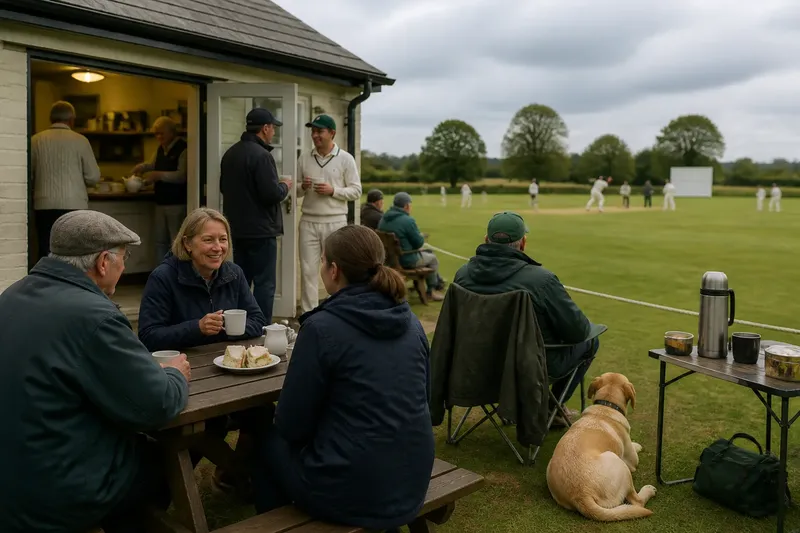
At a village match, pavilion tea or a touchline thermos can decide where people settle, whom they meet and how long they stay. One gathers people around a table; the other lets them keep their place by the rope, coat folded over a chair or dog waiting at their feet. Neither is the correct village custom. The useful question is what kind of welcome each makes possible.
What does pavilion tea make possible?
Pavilion tea turns refreshment into a small shared occasion. A pot, a plate of sandwiches and a seat indoors give people a reason to cross the ground and pause together. Players can arrive between innings, visiting supporters can ask where to sit, and regulars can exchange the sort of news that never makes the scorebook.
The room matters as much as the food. A pavilion with an open door and an obvious serving point is easy to approach; one that feels private, locked or reserved for members can leave newcomers hovering outside. A simple sign and someone willing to say “come in” can do more than an elaborate spread.
For the club, a shared table creates a natural place to offer tea, explain where the toilets are or introduce a visitor to someone who knows the ground. It also gives volunteers a visible task with a beginning and an end. The trade-off is that someone must prepare, serve and clear up, and the room may be busy just when the match is most absorbing.
Why does the touchline thermos feel different?
A thermos keeps refreshment close to the play. Spectators can pour a cup without abandoning a good view, and a player or parent can bring a drink to someone who would rather not make the trip indoors. It suits grounds where the pavilion is distant, the door is shut during a match, or the best conversation happens along the boundary.
This is a more mobile kind of hospitality. A flask, reusable cups and a small tin of biscuits can circulate among a few people without turning the afternoon into a catering operation. A thermos also works for those who want a quiet visit: they can watch, sip and leave when they need to, without entering a room where everyone already appears to know everyone else.
Its informality can, however, be hard to read. A flask beside one family’s chairs may look like a private arrangement, not an invitation. If sharing is intended, say so plainly or offer a cup to a neighbour. Keep hot drinks steady and away from the playing area; the relevant handling and serving advice depends on the container’s instructions and local requirements.
Which style suits whom?
Pavilion tea often suits a club that wants a common meeting point, has a usable room and can share the hosting among volunteers. It is especially helpful when spectators arrive at different times or visitors need a clear place to ask practical questions. The room gives a first-time guest somewhere to begin, provided the welcome is visible rather than assumed.
The touchline thermos tends to suit a dispersed crowd, a small gathering or a club whose matchday is deliberately light on formal arrangements. It can be useful where people bring children, dogs or mobility needs that make repeated trips indoors inconvenient. It also leaves spectators free to sit where they like instead of orbiting the pavilion.
There is no need to make the choice exclusive. A club might offer a pot in the pavilion while one or two flasks travel to the boundary, or use the room for tea before play and let spectators bring their own drinks outside. The point is not to build a refreshment system worthy of a county ground. It is to avoid mistaking one person’s habit for a rule everyone has understood.
How can a club choose without imposing a custom?
Start with the shape of the gathering, not an idealised picture of village hospitality. Ask where people naturally sit, whether the pavilion is easy to enter, and who is realistically available to host. If a room is awkward to find or volunteers are already occupied with scoring and equipment, a modest touchline arrangement may be kinder than another rota. If visitors keep arriving with nowhere obvious to go, a shared table can make the club easier to read.
Say a small club has a pavilion at the far end of the ground and only one volunteer free during a friendly. They could leave a clearly marked thermos and cups at a supervised boundary table, while keeping the pavilion open for anyone who wants shelter. The observable result they would hope for is a visible refreshment point without asking that volunteer to serve indoors throughout the match. If people still look unsure, a brief welcome from a player or scorer may be more useful than adding another sign.
Practical choices can also be made without turning hospitality into a policy document. Consider:
- Access: Is the pavilion easy to reach and enter, or does the boundary offer the simpler stop?
- Hosting: Is there someone who wants to make tea, or would a self-serve flask be more considerate?
- Company: Would visitors benefit from a shared table, or prefer to watch with a small group?
- Weather and shelter: Is there a dry, comfortable place to drink if the afternoon turns unsettled?
- Clarity: Can a newcomer tell whether the tea is for everyone, and where cups should go afterwards?
These questions are useful because they point to decisions, not standards. A club can change the arrangement from one match to the next without announcing a new tradition. It can also ask a visitor whether they would like to come in or stay by the rope, then accept the answer without treating it as a verdict on the club.
What do visitors usually want to know?
Is pavilion tea only for club members?
Not necessarily, but a closed door or an unexplained serving table can suggest that it is. A simple invitation from a player, scorer or host makes the arrangement clearer than assuming visitors will work it out.
Can spectators bring their own thermos?
Often that is the easiest option for someone who wants to stay at the boundary or has particular preferences. A club can welcome personal flasks while still offering shared tea, rather than making one arrangement stand for everyone.
Which option is better for a small club?
It depends less on the club’s size than on its space and volunteer capacity. A self-serve thermos may be the gentler choice when nobody can host, while a pavilion table can work well if someone enjoys welcoming people and clearing up.
Does offering both create confusion?
It need not, if the choices are visible and the invitation is plain. A sign at the pavilion door or a quick word by the boundary can explain where shared tea is available and whether spectators are welcome to bring their own.
What makes the welcome feel genuine?
Refreshment is a signal, not a measure of generosity. A carefully laid table can feel distant if nobody acknowledges a newcomer; an ordinary flask can be welcoming when someone shifts a chair and offers a cup. The detail that matters is whether people can understand how to join in without having to guess at club etiquette.
For a club weighing pavilion tea or a touchline thermos, choose the arrangement that fits the ground and the people who will actually maintain it. Make the invitation visible, leave room for a different preference and treat the tea towel or flask as support for the gathering, not its test. At a village match, a warm cup is useful; knowing where one is welcome is better.